Les presento las calificaciones finales preliminares del curso. Como acordamos el día miércoles estaré en la escuela para tratar cualquier asunto relacionado con dudas, revisión de tareas, diapositivas etc.
En caso de no tener duda sobre su resultado entonces atenderé únicamente a las personas que desean tener más información al respecto.
Les envío y cordial saludo y espero verlos pronto.
lunes, 13 de diciembre de 2010
viernes, 26 de noviembre de 2010
APEC
The Asian-Pacific Economic Cooperation (APEC) is a cooperative effort of 21 countries with a common goal of improving free trade in this region. First established in 1989 with 12 member countries in Canberra, Australia, APEC has made great strides in facilitating and improving trade among its member countries. In the first decade after its creation, the economies of the member nations accounted for 70% of global growth economically. Its members are, alphabetically, Australia, Brunei Darussalam, Canada, Chile, People's Republic of China, Hong Kong, China; Indonesia, Japan, Republic of Korea, Malaysia, Mexico, New Zealand, Papua New Guinea, Peru, the Republic of the Philippines, The Russian Federation, Singapore, Chinese Taipei, Thailand, United States of America, and Vietnam.
APEC’s 21 members represent 41% of the global population, 49% of international trade and 56% of the world’s Gross Domestic Product (GDP). There is no treaty to sign, rather APEC functions by consensus and cooperation. It adheres to the “Bogor Goals,” established in 1994 in Bogor, Indonesia. These goals are to have free and open trade and increased foreign investment in member economies by 2010 for developed economies, and 2020 for developing economies.
APEC works to establish anti-“protectionist” policies in member nations by reducing tariffs and doing away with other free-trade obstructions. By pooling resources, member nations can share information, and increase the wealth for businesses and individuals. APEC benefits citizens of member nations by creating more opportunity in the workplace, less expensive goods and services and increasing the ability to participate in the international market.
There are three main areas APEC focuses on:
1. Trade and Investment Liberalization: In this area, APEC works to reduce tariffs and remove other obstructions to free trade.
2. Business Facilitation: In this area, the goal is to facilitate business interactions between member nations by reducing the cost of doing business, sharing trade information and improving the relationships of importers and exporters.
3. Economic and Technical Cooperation (ECOTECH):This program includes opportunities for member nations to improve training and education in international trade.
APEC has met every year since 1993, and in addition to its goals, discusses evolving issues such as women in APEC, terrorism, transparency standards, corruption and pandemics that potentially affect trade. Every year, one member country plays host to the meeting. APEC is funded by a relatively small annual contribution from each member country, totaling approximately $3.38 million US Dollars (USD) per year. These funds pay for APEC programs as well as a small Secretariat located in Singapore. Leadership in the Secretariat rotates, depending on who is hosting the meeting that year— the Executive Director is from the host country that year, and the Deputy Executive Director is from next year’s host country.
APEC’s 21 members represent 41% of the global population, 49% of international trade and 56% of the world’s Gross Domestic Product (GDP). There is no treaty to sign, rather APEC functions by consensus and cooperation. It adheres to the “Bogor Goals,” established in 1994 in Bogor, Indonesia. These goals are to have free and open trade and increased foreign investment in member economies by 2010 for developed economies, and 2020 for developing economies.
APEC works to establish anti-“protectionist” policies in member nations by reducing tariffs and doing away with other free-trade obstructions. By pooling resources, member nations can share information, and increase the wealth for businesses and individuals. APEC benefits citizens of member nations by creating more opportunity in the workplace, less expensive goods and services and increasing the ability to participate in the international market.
There are three main areas APEC focuses on:
1. Trade and Investment Liberalization: In this area, APEC works to reduce tariffs and remove other obstructions to free trade.
2. Business Facilitation: In this area, the goal is to facilitate business interactions between member nations by reducing the cost of doing business, sharing trade information and improving the relationships of importers and exporters.
3. Economic and Technical Cooperation (ECOTECH):This program includes opportunities for member nations to improve training and education in international trade.
APEC has met every year since 1993, and in addition to its goals, discusses evolving issues such as women in APEC, terrorism, transparency standards, corruption and pandemics that potentially affect trade. Every year, one member country plays host to the meeting. APEC is funded by a relatively small annual contribution from each member country, totaling approximately $3.38 million US Dollars (USD) per year. These funds pay for APEC programs as well as a small Secretariat located in Singapore. Leadership in the Secretariat rotates, depending on who is hosting the meeting that year— the Executive Director is from the host country that year, and the Deputy Executive Director is from next year’s host country.
APEC's Growth Strategy for the Asia-Pacific Region
For nearly three years, the global economy has experienced much turbulence. Many of the world's regions have stagnated and are only recently beginning to turn around. But among global economies, the Asia-Pacific region is leading the way with a robust recovery.
According to the latest report by the International Monetary Fund (IMF), growth rates of 15 percent are expected in Singapore. Elsewhere in the region, China and Thailand are projected to grow by 10.5 percent and 7.5 percent respectively.1 Other APEC members such as Japan, Australia and New Zealand are also reported to be recovering positively.
These economies, and others within APEC, have continued to perform well despite the seriousness of the recent global crisis. Many APEC economies saw a solid recovery as early as 2009. Growth rates in the region have also continued this upward momentum in the first quarter of 2010. IMF economists predict this to continue, but at a more sustainable pace of 6.8 percent next year.
With the region forging ahead, APEC's work on liberalizing and facilitating trade, investment and cooperation within the region continues to act as a key driver for growth and prosperity. APEC was well positioned to respond quickly and deal with the crisis effectively. APEC's actions included committing to a standstill on protectionist measures, intensifying ongoing work to accelerate regional economic integration, and laying out the foundation to ensure that growth carries on and development continues in the long-term.
Essentially what APEC took from the crisis is the realization that the region can no longer return to "growth as usual." It has been recognized that the quality of growth must be improved in order for APEC economies to continue to develop, to address new challenges, and to remain dynamic. As a result, in 2009, APEC Leaders committed to forge a new comprehensive growth paradigm for the post-crisis landscape.
Japan - as APEC's host economy for 2010 - has led the development of this plan. Coined as the "APEC Growth Strategy", this is an approach to economic development that takes into consideration new challenges and global realities, such as energy and environmental constraints, human security concerns, the necessity of constant innovation, and economic performance and opportunity disparities across and within economies.
This is also "a strategy towards common growth" for every APEC economy to pursue, says Dr. Takashi Omori, the Chair of APEC's Economic Committee.2 Thus in August 2010, all members of APEC - including ministers from economies and top officials from the Asian Development Bank, the International Energy Agency, and the World Bank - met for the first time in Beppu, Japan to deliberate on this new strategy. This culminated in the Beppu Declaration which provided the basis for further discussion at the last APEC Senior Officials' Meeting in September 2010.
"Formerly economies just wanted to grow fast to make people wealthy," says Hidehiko Nishiyama, co-Chair of the Senior Officials' Meeting for APEC Japan 2010, "but that approach has created its own problems." With climate change and other human security concerns arising, there is an urgency to create growth that can be sustained for future generations to come; and therefore there is necessity, adds Nishiyama, "to improve the quality, as opposed to just the rate of growth."
As APEC Trade Ministers have aptly pointed out in their June 2010 meeting, the region's long-term economic trajectory needs to be balanced, inclusive, sustainable, innovative, and secure, in order to achieve further prosperity and collective well-being. These ideas make up the five attributes of the APEC Growth Strategy; and these attributes will guide APEC economies towards realising higher quality growth in the region.
This first attribute, Balanced Growth, refers to dealing with the imbalances that exist both between and within economies. Better social safety nets - such as pensions, healthcare and education - need to be put in place so that domestic and regional consumption can be boosted. This also means more focus on economic structural reforms such as competition policies and reducing regulatory burdens.
Realising the second attribute of Inclusive Growth would allow everyone to benefit from trade and ensure as many citizens as possible have the opportunity to improve their lives. This will be translated into action through initiatives that promote job creation, enhance human resources and small business development, create new economic opportunities for women, and improve access to finance.
The third attribute, Sustainable Growth, refers to the need to make growth compatible with environmental imperatives and energy constraints. Already APEC has embarked on new projects that focus on improving the energy efficiency of sectors such as transportation and power generation and initiatives that expand the potential use of renewable energy sources to accelerate the move to a low-carbon economy.
Creating an environment that promotes and facilitates the development and commercialization of ideas is what the fourth attribute, Innovative Growth, is all about. This attribute is achieved through initiatives that provide policy and regulatory infrastructure conducive to innovation, such as intellectual property rights protection, information and communication technology application, and research and development promotion.
The fifth and final attribute, Secure Growth, refers to protecting people, businesses and economies from natural disasters, health pandemics or human-made interference that reduce an economy's productive capacity. Projects that promote good policies and practice in areas such as counter-terrorism, preventing and countering of emergency preparedness, diseases, and food security help realise this goal.
"This agenda comes out of a number of forces for change," says Christopher Findlay, a University of Adelaide economics professor in an article to the East Asia Forum earlier this year, "including the response to the global financial crisis, the concerns which have been raised about the distribution of the benefits of growth within economies (and between them), the intersection of these developments with the climate change debate, and the twittering rate of technological change in the digital world."
APEC is continuing its traditional role of building confidence in these areas - through a process of dialogue, pathfinder initiatives, and persuasion - to make change. But as a consequence of numerous past successes, adds Findlay, "APEC has a new role as the driver of structural change."
The global economy is counting on the Asia-Pacific to continue to lead the way forward. The APEC region, "is the world's growth engine," says Nishiyama, "so it bears a great responsibility for the future course of the global economy, and the livelihoods and welfare of many."
In the coming days, APEC Leaders will meet again for the 18th time in Yokohama, Japan. Discussion on the APEC Growth Strategy is likely to be at the top of the meeting's agenda.
Over the years, APEC has proven that by working together the region's economies can generate robust growth. Now APEC Leaders are poised to show the world that growth can also be balanced, inclusive, sustainable, innovative and secure. Indeed, the APEC region is well placed to demonstrate its global leadership. With a resilience that has led the world through the economic crisis, APEC's next endeavor will be to redefine growth - and in doing so, APEC will likely serve as an example to economies and regions around the globe.
According to the latest report by the International Monetary Fund (IMF), growth rates of 15 percent are expected in Singapore. Elsewhere in the region, China and Thailand are projected to grow by 10.5 percent and 7.5 percent respectively.1 Other APEC members such as Japan, Australia and New Zealand are also reported to be recovering positively.
These economies, and others within APEC, have continued to perform well despite the seriousness of the recent global crisis. Many APEC economies saw a solid recovery as early as 2009. Growth rates in the region have also continued this upward momentum in the first quarter of 2010. IMF economists predict this to continue, but at a more sustainable pace of 6.8 percent next year.
With the region forging ahead, APEC's work on liberalizing and facilitating trade, investment and cooperation within the region continues to act as a key driver for growth and prosperity. APEC was well positioned to respond quickly and deal with the crisis effectively. APEC's actions included committing to a standstill on protectionist measures, intensifying ongoing work to accelerate regional economic integration, and laying out the foundation to ensure that growth carries on and development continues in the long-term.
Essentially what APEC took from the crisis is the realization that the region can no longer return to "growth as usual." It has been recognized that the quality of growth must be improved in order for APEC economies to continue to develop, to address new challenges, and to remain dynamic. As a result, in 2009, APEC Leaders committed to forge a new comprehensive growth paradigm for the post-crisis landscape.
Japan - as APEC's host economy for 2010 - has led the development of this plan. Coined as the "APEC Growth Strategy", this is an approach to economic development that takes into consideration new challenges and global realities, such as energy and environmental constraints, human security concerns, the necessity of constant innovation, and economic performance and opportunity disparities across and within economies.
This is also "a strategy towards common growth" for every APEC economy to pursue, says Dr. Takashi Omori, the Chair of APEC's Economic Committee.2 Thus in August 2010, all members of APEC - including ministers from economies and top officials from the Asian Development Bank, the International Energy Agency, and the World Bank - met for the first time in Beppu, Japan to deliberate on this new strategy. This culminated in the Beppu Declaration which provided the basis for further discussion at the last APEC Senior Officials' Meeting in September 2010.
"Formerly economies just wanted to grow fast to make people wealthy," says Hidehiko Nishiyama, co-Chair of the Senior Officials' Meeting for APEC Japan 2010, "but that approach has created its own problems." With climate change and other human security concerns arising, there is an urgency to create growth that can be sustained for future generations to come; and therefore there is necessity, adds Nishiyama, "to improve the quality, as opposed to just the rate of growth."
As APEC Trade Ministers have aptly pointed out in their June 2010 meeting, the region's long-term economic trajectory needs to be balanced, inclusive, sustainable, innovative, and secure, in order to achieve further prosperity and collective well-being. These ideas make up the five attributes of the APEC Growth Strategy; and these attributes will guide APEC economies towards realising higher quality growth in the region.
This first attribute, Balanced Growth, refers to dealing with the imbalances that exist both between and within economies. Better social safety nets - such as pensions, healthcare and education - need to be put in place so that domestic and regional consumption can be boosted. This also means more focus on economic structural reforms such as competition policies and reducing regulatory burdens.
Realising the second attribute of Inclusive Growth would allow everyone to benefit from trade and ensure as many citizens as possible have the opportunity to improve their lives. This will be translated into action through initiatives that promote job creation, enhance human resources and small business development, create new economic opportunities for women, and improve access to finance.
The third attribute, Sustainable Growth, refers to the need to make growth compatible with environmental imperatives and energy constraints. Already APEC has embarked on new projects that focus on improving the energy efficiency of sectors such as transportation and power generation and initiatives that expand the potential use of renewable energy sources to accelerate the move to a low-carbon economy.
Creating an environment that promotes and facilitates the development and commercialization of ideas is what the fourth attribute, Innovative Growth, is all about. This attribute is achieved through initiatives that provide policy and regulatory infrastructure conducive to innovation, such as intellectual property rights protection, information and communication technology application, and research and development promotion.
The fifth and final attribute, Secure Growth, refers to protecting people, businesses and economies from natural disasters, health pandemics or human-made interference that reduce an economy's productive capacity. Projects that promote good policies and practice in areas such as counter-terrorism, preventing and countering of emergency preparedness, diseases, and food security help realise this goal.
"This agenda comes out of a number of forces for change," says Christopher Findlay, a University of Adelaide economics professor in an article to the East Asia Forum earlier this year, "including the response to the global financial crisis, the concerns which have been raised about the distribution of the benefits of growth within economies (and between them), the intersection of these developments with the climate change debate, and the twittering rate of technological change in the digital world."
APEC is continuing its traditional role of building confidence in these areas - through a process of dialogue, pathfinder initiatives, and persuasion - to make change. But as a consequence of numerous past successes, adds Findlay, "APEC has a new role as the driver of structural change."
The global economy is counting on the Asia-Pacific to continue to lead the way forward. The APEC region, "is the world's growth engine," says Nishiyama, "so it bears a great responsibility for the future course of the global economy, and the livelihoods and welfare of many."
In the coming days, APEC Leaders will meet again for the 18th time in Yokohama, Japan. Discussion on the APEC Growth Strategy is likely to be at the top of the meeting's agenda.
Over the years, APEC has proven that by working together the region's economies can generate robust growth. Now APEC Leaders are poised to show the world that growth can also be balanced, inclusive, sustainable, innovative and secure. Indeed, the APEC region is well placed to demonstrate its global leadership. With a resilience that has led the world through the economic crisis, APEC's next endeavor will be to redefine growth - and in doing so, APEC will likely serve as an example to economies and regions around the globe.
jueves, 25 de noviembre de 2010
lunes, 22 de noviembre de 2010
Mercado Comun Centroamericano MCCA / (SICA)
La idea de una Centroamérica unida se puede encontrar ya a comienzos del siglo XIX. Después de la independencia de México de España, cinco naciones centroamericanas, Costa Rica, El Salvador, Guatemala, Honduras y Nicaragua formaron la Federación Centroamericana en 1824. A pesar de que la Federación se desintegró en 1838, la aspiración de unidad en el istmo persistió dando lugar a una serie de proyectos parciales de asociación regional. Uno de estos proyectos fue la Organización de Estados Centroamericanos (ODECA) establecida en 1951 como un foro político para promover la cooperación e integración entre sus miembros. A comienzos de los años 50, la CEPAL participó en el proyecto de integración aportando un argumento económico, profundamente influenciado por el paradigma de la industrialización por sustitución de importaciones. Los esfuerzos iniciales de integración fueron lentos a través de una serie de acuerdos bilaterales debido a la ausencia de una estructura formal para lograr las metas trazadas.
El Tratado Multilateral de Libre Comercio e Integración Centroamérica, firmado en 1958, brindó una perspectiva común centroamericana y ordenó el establecimiento de un área de libre comercio en un plazo de diez años. Dos años después, en diciembre de 1960, El Salvador, Guatemala, Honduras y Nicaragua firmaron el Tratado General de Integración Económica Centroamericano por el cual se crea el marco básico para la integración económica y se establece el Mercado Común Centroamericano – MCCA. El Tratado General previó el establecimiento de un mercado común y una unión aduanera en el plazo de cinco años. Costa Rica adhirió al tratado en 1962.
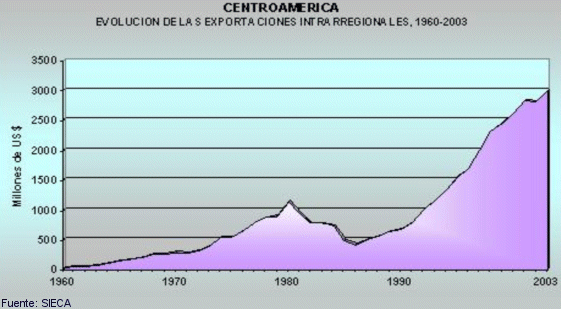
Durante las dos primeras décadas de existencia del MCCA, el comercio intrarregional y la IED (véase cuadro 1) contribuyeron a la industrialización de la región. Sin embargo, a fines de los años sesenta, problemas políticos provocaron que Honduras saliera del MCCA. Además, las muestras de agotamiento del modelo ISI y la devaluación unilateral de la moneda como respuesta a la crisis petrolera provocaron el restablecimiento de restricciones comerciales entre los miembros. En los años ochenta, guerras civiles y problemas con la deuda externa causaron grandes dificultades en materia de pagos en los países y, como consecuencia, el comercio interregional se contrajo más del 50% entre 1980 y 1986.
En 1991, las cinco repúblicas centroamericanas y Panamá firmaron en Honduras el Protocolo de Tegucigalpa a la Carta de la ODECA de 1962 estableciendo el nuevo marco jurídico e institucional, el Sistema de Integración Centroamericana (SICA). Los miembros de este sistema constituyen una comunidad económica-política cuyo objetivo fundamental es convertir a Centroamérica en una región de Paz, Libertad, Democracia y Desarrollo.
La Secretaría del SICA coordina y ejecuta los mandatos que deriven de las Reuniones de Presidentes (órgano supremo), Consejos de Ministros de Relaciones Exteriores y Comité Ejecutivo. SICA comprende todas las entidades existentes incluyendo aquellas encargadas de funciones ejecutivas (reuniones cumbre, comisiones ministeriales y otras funciones judiciales (Corte Centroamericana de Justicia ) y legislativas (Parlamento Centroamericano ). En materia de alcance, SICA comprende los subsistemas político, económico, social, cultural y medioambiental. A pesar de que Panamá y Belice, quien se adhirió en el 2000, son miembros plenos de SICA no participan en el subsistema de integración económica de SICA.
En 1993, con el fin de lograr los objetivos planteados en materia económica se estableció el compromiso de concretar una unión económica que permita a la región insertarse en la economía mundial, a tales efectos los seis presidentes centroamericanos se reunieron nuevamente para firmar el Protocolo de Integración Económica Centroamericana al Tratado General sobre Integración Centroamericana, Protocolo de Guatemala , mediante el cual reiteraron su compromiso de crear una unión aduanera y una unión monetaria sin establecer una fecha limite específica. A través de este protocolo se establecieron también el marco institucional del subsistema económico del SICA. El Consejo de Ministros para la Integración Económica, integrado por ministros de economía y presidentes de los bancos centrales, asumió la responsabilidad de coordinar las políticas económicas, ayudado por ambos Consejos (de Ministros Sectoriales e Intersectoriales). El subsistema económico se completa con tres órganos técnico-administrativos (la Secretaria para la Integración Económica, la Secretaria del Consejo de Agricultura, y la Secretaria del Consejo Monetario) así como también tres instituciones técnicas, el Banco para la Integración Económica, el Instituto para la Administración Pública, y el Instituto para la Tecnología Industrial y la Investigación (actualmente clausurado).
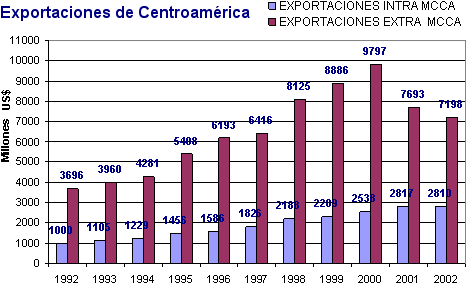
El MCCA ha sido exitoso en establecer un área de libre comercio en América Central . El Tratado General estableció que todos los productos con certificado nacional de origen disfrutaban de libre comercio a excepción de una lista de productos enumerados en el Anexo A. La lista de excepciones ha decrecido con el pasar del tiempo y en la actualidad aplica solamente al café, azúcar, bebidas alcohólicas y productos petroleros. Como resultado del comercio intrarregional se ha incrementado en volumen e importancia, particularmente durante los noventa (véase cuadro 2). De hecho, en el 2002 las exportaciones intrarregionales alcanzaron cerca de 2.8 mil millones de dólares americanos, y a 3.4300 millones en el 2004 lo cual equivale aproximadamente al 30 por ciento del total de las exportaciones de América Central
Los países centroamericanos han estado buscando la negociación de nuevos acuerdos comerciales con otros países en las Américas, tanto individualmente o como parte del Mercado Común Centroamericano.
Negociaciones Concluidas
No obstante, los miembros del MCCA han tenido algunas dificultades en articular posturas externas como bloque. Las relaciones económicas con México ilustran esta situación. Los acuerdos de Tuxtla Gutiérrez I (1991) tienen gran importancia en las relaciones comerciales entre México y los países Centroamericanos en general, dado que sirvieron como base para la integración comercial de la región. A través de este instrumento se establecieron entre México y los países centroamericanos siete programas de cooperación económica (liberalización comercial, financiera, cooperación en el sector primario, abastecimiento energético, etc), sin embargo el más exitoso fue el de liberalización comercial. Entre los resultados más importantes de esta relación se pueden destacar la suscripción de los Tratados de Libre Comercio entre México y los países centroamericanos, la incorporación al Mecanismo del Plan Puebla Panamá, como instrumento impulsor del desarrollo y la integración regional, avances en los ámbitos económico, comercial y financiero, cooperación técnica así como en el ámbito político.
Entre los acuerdos resultado del los Acuerdos Tuxtla Gutiérrez podemos señalar los acuerdos firmados por El Salvador, Guatemala y Honduras con México, conocido como México - Triángulo del Norte.
EL PACTO ANDINO O COMUNIDAD
RESUMEN:
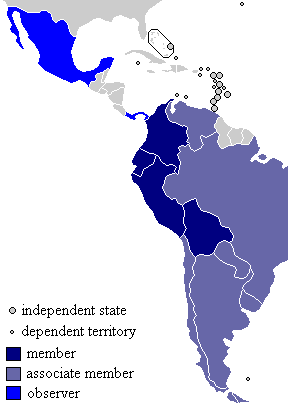
Está constituida por Bolivia, Colombia, Ecuador, y Perú y los órganos e instituciones del Sistema Andino de Integración (SAI). Antes de 1996, era conocida como el Pacto Andino o Grupo Andino.
Venezuela fue miembro hasta el 2006. Chile originalmente fue miembro entre 1969-1976, pero se retiró durante el Régimen militar de Augusto Pinochet debido a incompatibilidades entre la política económica de ese país y las políticas de integración de la CAN. Este país se reintegró a la CAN como miembro asociado el 20 de septiembre de 2006.
Ubicados en América del Sur, los cuatro países andinos agrupan a casi 100 millones de habitantes en una superficie de 3.798.000 kilómetros cuadrados, cuyo Producto Interno Bruto se estima ascendería en el 2007 a 280.392 millones de dólares.
Acuerdo de integración Subregional Andina. Firmado por Bolivia, Colombia, Ecuador, Perú y Venezuela. Su objetivo es promover el desarrollo equilibrado y común de los países miembros: armonización del tratamiento de la inversión extranjera y supresión de las barreras de comercio.
_________________________
En 1969, exactamente el 26 de mayo, Colombia, Chile, Bolivia, Perú y Ecuador firman el Acuerdo de Cartagena constituyendo la organización que ha venido ha conocerse como el Pacto Andino, o el Grupo Andino.
Estos cinco países soberanos tenían entonces un propósito común, el de mejorar el nivel de vida de sus habitantes, mediante la cooperación, tanto social como económica, y la integración.
Años más tarde, en 1973, Venezuela decidió unirse al Pacto Andino, mientras que Chile lo abandonaba en 1976 para volver a formar parte en 2006, esta vez como país asociado. En la actualidad la composición final del Pacto Andino es la siguiente: los países miembros son: Bolivia, Colombia, Ecuador y Perú. Como países asociados figuran Brasil, Argentina, Chile, Paraguay y Uruguay. Finamente existen dos países observadores que son Panamá y México.
Como sucede en cualquier tipo de organismo internacional, los avances y retrocesos de Pacto Andino han sido numerosos. Intentaremos a continuación resumirlos en una breve historia de su andadura.
Durante la primera década de existencia, la década de los setenta, se forman casi todas las instituciones y organismos que rigen el Pacto Andino, a excepción del Consejo Presidencial Andino, que nació en 1990. Durante este primer periodo, la política reinante fue la de protección de la industria nacional, potenciando el consumo del producto interior y cargando con fuertes aranceles las importaciones extranjeras.
En la siguiente década, la de los ochenta, este modelo entra en una fuerte crisis y fue prácticamente una década perdida tanto para los países del Pacto como para los asociados y observadores. La integración sufrió un estancamiento en toda la zona.
A finales de esta década, en 1989, se decide finalmente abandonar este modelo “cerrado” y optar por uno “abierto”. Esta decisión se ratifica en una reunión llevada a cabo en Galápagos, Ecuador. De las conclusiones de esta reunión se pueden destacar la prioridad que se otorgan a los temas comerciales y mercantiles. Un ejemplo es la adopción de Diseño Estratégico y un Plan de Trabajo, donde el tema comercial era el predominante.
En 1993 se eliminan definitivamente los aranceles y se forma una zona de libre comercio entre los países asociados, las mercancías empiezan a circular libremente en la zona del Pacto Andino, por lo que el comercio crece enormemente y, gracias a esta circunstancia, se crean miles de nuevos puestos de trabajo. Se promueve la liberación de los servicios, en especial del transporte en todas sus modalidades.
En 1997 se firma el Protocolo de Trujillo que introduce ciertas reformas en el Acuerdo de Cartagena para adaptarlo al actual entorno internacional, que tanto había variado desde 1969. Los Presidentes pasan a ser los conductores del cambio, y los nuevos órganos se incorporan a la estructura de la Comunidad Andina, como a partir de ahora se conocerá el organismo: el Consejo Presidencial Andino y el Consejo Andino de Ministros de Relaciones Exteriores.
En la década actual, a principios del siglo XX, con las necesidades comerciales y mercantiles desarrolladas y consolidadas, las prioridades sociales y de integración seguían siendo el punto débil de la Comunidad Andina. Este será el objetivo de estos años. En 2003, en Quirama, se establece por mandato presidencial un Plan Integrado de Desarrollo Social que responda a los objetivos iniciales del Acuerdo de Cartagena, abandonados en pro de unos beneficios de tintes más económicos. Este cambio de orientación queda finalmente reflejado en el Plan de Trabajo de la Secretaría General de la Comunidad Andina de 2007, cuyas áreas de acción son: la Agenda Social, Agenda Ambiental, Cooperación Política, Relaciones Externas y Desarrollo Productivo y Comercial.
En sus 38 años de existencia la Comunidad Andina ha alcanzado logros que no se circunscriben únicamente al campo mercantil. Algunos de los más significativos son:
• Hoy para viajar a cualquiera de los países de la CAN ya no necesitan pasaporte ni visas. Basta con los documentos nacionales de identidad.
• Cuentan con normas comunitarias que garantizan la circulación y permanencia de nacionales andinos en la subregión con fines laborales sin perder sus derechos a la seguridad social.
• Se ha comenzado a hacer realidad la elección por voto popular y directo de los parlamentarios andinos.
• Tienen un Plan Integrado de Desarrollo Social para trabajar en temas de empleo, salud, educación, etc.
• Tienen una Agenda Ambiental
Consejo Andino de Ministros de Relaciones Exteriores.
En la década actual, a principios del siglo XX, con las necesidades comerciales y mercantiles desarrolladas y consolidadas, las prioridades sociales y de integración seguían siendo el punto débil de la Comunidad Andina. Este será el objetivo de estos años. En 2003, en Quirama, se establece por mandato presidencial un Plan Integrado de Desarrollo Social que responda a los objetivos iniciales del Acuerdo de Cartagena, abandonados en pro de unos beneficios de tintes más económicos. Este cambio de orientación queda finalmente reflejado en el Plan de Trabajo de la Secretaría General de la Comunidad Andina de 2007, cuyas áreas de acción son: la Agenda Social, Agenda Ambiental, Cooperación Política, Relaciones Externas y Desarrollo Productivo y Comercial.
En sus 38 años de existencia la Comunidad Andina ha alcanzado logros que no se circunscriben únicamente al campo mercantil. Algunos de los más significativos son:
• Hoy para viajar a cualquiera de los países de la CAN ya no necesitan pasaporte ni visas. Basta con los documentos nacionales de identidad.
• Cuentan con normas comunitarias que garantizan la circulación y permanencia de nacionales andinos en la subregión con fines laborales sin perder sus derechos a la seguridad social.
• Se ha comenzado a hacer realidad la elección por voto popular y directo de los parlamentarios andinos.
• Tienen un Plan Integrado de Desarrollo Social para trabajar en temas de empleo, salud, educación, etc.
• Tienen una Agenda Ambiental
Suscribirse a:
Entradas (Atom)